
Keno vs Bingo: What’s the Difference?
When people compare keno vs bingo, they often assume the two games are closely related. That makes sense on the surface. Both involve numbers, both rely heavily on chance, and both are popular in casual gaming environments. However, once you look beyond the basics, the differences between keno and bingo become much clearer.
Understanding keno vs bingo is useful for anyone researching number-based games, writing educational content, or simply trying to understand how these formats work. Although both games revolve around matching numbers, they differ in game structure, pace, player interaction, ticket format, prize systems, and the overall playing experience.
In this guide, we will break down the most important keno vs bingo differences in simple terms. We will also explain where the games overlap, what makes each one unique, and why they should not be treated as the same thing.
What Is Keno?
Keno is a number-draw game in which players choose a set of numbers from a larger pool. After that, a group of winning numbers is drawn randomly. The prize depends on how many numbers the player selected and how many of those numbers match the final draw. Players who want to try both formats in one place can also compare online casinos where both keno and bingo are available.
In many common versions of keno, the number pool ranges from 1 to 80. Players often choose anywhere from 1 to 20 numbers, depending on the rules. Once the choices are locked in, a fixed number of winning numbers is drawn. If the player’s selected numbers match some or all of the drawn results, the ticket may win according to the game’s paytable.
Keno is generally known for flexibility and speed. In many formats, players can decide how many numbers they want to select, how much they want to stake, and sometimes whether they want to enter one draw or several consecutive draws. That makes keno feel highly structured but also customizable. Players who want to try this format in practice can compare crypto casinos with lottery-style keno games before choosing a platform.
What Is Bingo?
Bingo is a number-matching game where players mark off numbers on a card as those numbers are announced or drawn. The objective is usually to complete a specific pattern before other players do. That pattern might be a straight line, four corners, a full house, or another predefined shape, depending on the version of the game.
Traditional bingo is often played on a card made up of a grid filled with numbers. As the numbers are called, players mark the ones that appear on their card. If a player completes the winning pattern first, they call out “Bingo” and the win is checked.
Unlike keno, bingo is usually more interactive and communal. It often includes multiple players competing in the same round, and the winner is typically the first person to complete the required pattern. This creates a very different atmosphere from keno, even though both games rely on numbers and random draws.
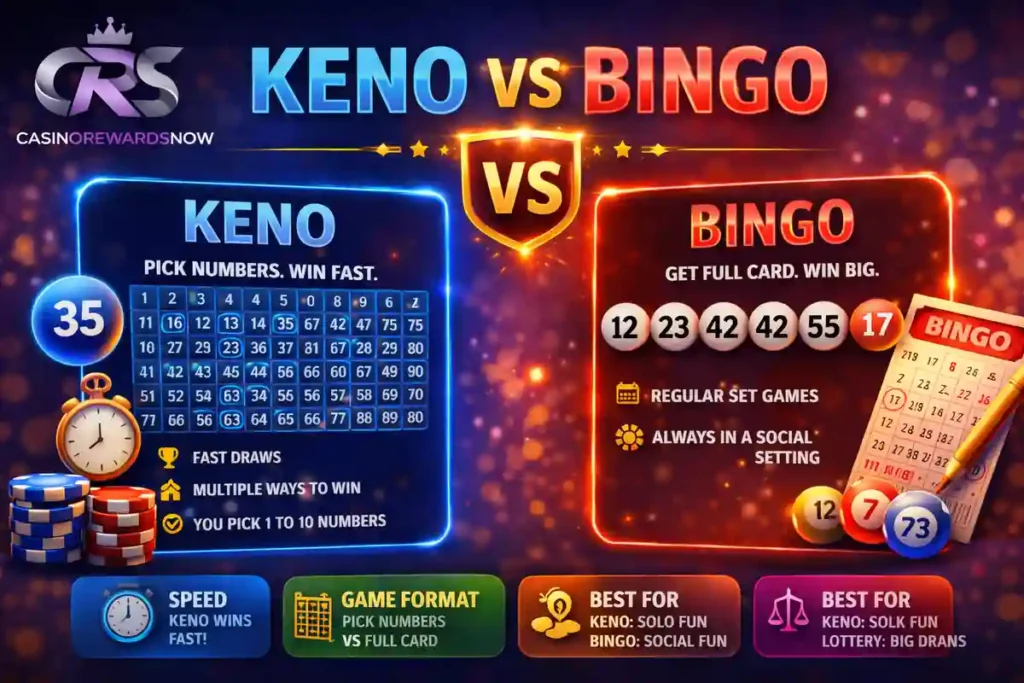
Keno vs Bingo at a Glance
Before going deeper, here is a quick comparison table showing the main keno vs bingo differences.
| Feature | Keno | Bingo |
|---|---|---|
| Basic format | Pick numbers before the draw | Mark numbers on a card as they are called |
| Number pool | Often 1 to 80 | Commonly based on bingo card formats such as 75-ball or 90-ball |
| Player interaction | Usually low | Usually higher |
| Winning method | Match selected numbers to drawn results | Complete a required pattern before others |
| Pace | Often fast and draw-based | Often social and round-based |
| Prize structure | Usually based on paytables | Usually based on completing patterns or winning rounds |
| Ticket/card style | Number selection slip or digital entry | Printed or digital bingo card |
| Competitive aspect | Usually player vs draw | Often player vs other players |
This table alone shows why keno vs bingo is a meaningful comparison. The two games may look similar at a basic level, but the mechanics are quite different.
The Core Difference Between Keno and Bingo
The simplest way to explain keno vs bingo is this: in keno, the player chooses numbers first and then waits to see how many match the draw. In bingo, the player receives or buys a card and then marks off numbers as they are called, trying to complete a pattern before other players.
That difference affects everything else.
Keno is built around prediction and matching. Bingo is built around progression and pattern completion. Keno is more static once the ticket is submitted. Bingo is more active during the round because players continue following the called numbers and watching the card develop in real time.
1. Number Selection and Card Structure
One of the biggest keno vs bingo differences is how the player interacts with numbers at the start of the game.
In keno, players usually choose their own numbers. They may select 4, 8, 10, or another allowed amount depending on the format. This gives the player a sense of control over the ticket setup, even though the outcome is still random.
In bingo, players typically play with a pre-arranged card. The numbers are already placed in a grid or card layout. The task is not to choose numbers strategically, but to mark them when they are called. In many cases, players buy one or multiple cards rather than building their own number combinations.
This means keno feels more like a number-picking game, while bingo feels more like a number-tracking game.
2. Winning Conditions
Another important point in keno vs bingo is how a win actually happens.
In keno, winning is based on how many of your selected numbers match the drawn numbers. The more matches you get, the better the payout is likely to be. The game usually follows a paytable that explains what each result is worth.
In bingo, winning depends on completing a predefined pattern on the card. For example, a player may need to fill one horizontal line, two lines, or the entire card. The first player to complete the required pattern and confirm it wins the round.
So while keno focuses on numerical match count, bingo focuses on card pattern completion. That is one of the clearest structural differences between the two games.
3. Individual Play vs Social Play
Keno is often more individual in nature. Even when many people are playing at the same time, the experience usually feels personal. A player chooses numbers, watches the draw, and checks the outcome. The game is generally about the player’s own ticket rather than a direct competition against others.
Bingo is usually much more social. It is commonly played in groups, whether in physical halls, community venues, or digital rooms. The sense of shared participation is part of the appeal. Players often follow the same calls at the same time, and there is a stronger awareness that others are competing in the same round.
This social element is a major part of the keno vs bingo discussion. Keno tends to feel solitary or ticket-focused, while bingo often feels communal and interactive.
4. Pace and Game Rhythm
Keno is usually faster in structure. In many formats, the draw happens quickly and results are known soon after the ticket is placed. Some versions even allow frequent consecutive draws, which creates a rapid pace.
Bingo usually unfolds in stages. Numbers are called one by one, and the suspense builds as players get closer to completing the winning pattern. The pace can vary, but it is often more gradual than keno because the round develops over time rather than being decided all at once.
This difference matters because it shapes the emotional experience. Keno can feel immediate and efficient. Bingo can feel slower, more dramatic, and more engaging from moment to moment. Readers who prefer shorter sessions can also explore fast-play casinos with keno and bingo to see how these formats feel in a real-money setting.
5. Prize Structure and Payout Logic
Prize design is another essential area when comparing keno vs bingo.
Keno generally uses a paytable. The amount you win depends on the number of spots you selected, how many matches you achieved, and sometimes how much you wagered. Payouts are often fixed according to the game rules.
Bingo usually awards prizes based on the round outcome. The prize might go to the first player who completes the required pattern, and the amount may depend on the game setup, number of participants, ticket sales, or operator rules. Some bingo variants award multiple prizes within the same round, such as one-line prizes and full-house prizes.
This means keno often feels more formula-based, while bingo can feel more event-based and competitive.
6. Skill vs Chance
Both keno and bingo are games of chance. Random number drawing is central to both formats, and players do not control the actual outcomes once the round begins.
That said, the perception of player involvement is different.
In keno, the player’s main action is choosing numbers before the draw. After that, the outcome is entirely dependent on the random selection of winning numbers.
In bingo, players remain active during the round by watching the card, marking called numbers, and recognizing when a pattern is complete. This does not change the randomness of the draw, but it does create a stronger sense of participation.
So from a technical perspective, both are chance-based games. From a user-experience perspective, bingo often feels more active.
7. Environment and Atmosphere
Keno and bingo are often associated with different atmospheres.
Keno is commonly linked with gaming environments, digital number games, and fast-play formats. It often feels streamlined and result-oriented. The main focus is on the draw and the outcome.
Bingo is more often associated with community settings, social halls, clubs, charity events, and interactive rooms. Even online, bingo often tries to preserve that sense of group play and shared momentum.
This does not mean the two games cannot overlap in venue, but it does mean that their brand identity is often very different. When people search for keno vs bingo, they are often really comparing not only mechanics, but also the kind of experience each game offers. For readers comparing the practical playing environment, it also helps to look at casinos that offer both bingo and keno alongside other casual game formats.
8. Complexity and Ease of Understanding
Keno is usually easy to understand at a basic level: choose numbers, wait for the draw, count your matches. However, the presence of different spot counts, paytables, and wager options can make some versions slightly more detailed.
Bingo is also easy to understand: mark numbers as they are called and complete the winning pattern. For many people, this feels intuitive because the visual card format is simple to follow.
The difference is that keno involves more setup decisions, while bingo involves more in-round attention. One is not necessarily harder than the other, but they challenge the player in different ways.
9. Keno vs Bingo Comparison Table
Here is a deeper table that highlights the practical differences between the two.
| Comparison Area | Keno | Bingo |
|---|---|---|
| Main player action | Select numbers before draw | Mark numbers during the round |
| Outcome style | Based on number matches | Based on pattern completion |
| Customization | Often higher | Usually lower on number choice, higher on card count |
| Round experience | Mostly passive after ticket purchase | More active throughout the game |
| Social interaction | Usually limited | Often strong |
| Common appeal | Fast results and flexible tickets | Social play and real-time suspense |
| Competition style | Mostly against the draw/paytable | Often against other players |
| Typical format identity | Number draw game | Pattern-based community game |
This comparison shows why keno vs bingo is not just a minor distinction. The two games are built around different player experiences.
10. Similarities Between Keno and Bingo
Even though there are important differences, keno and bingo do have a few things in common.
Both games are based on numbers. Both use random draws or number calls. Both rely mostly on chance rather than skill. Both are easy for beginners to understand. And both are widely recognized as accessible formats for casual players.
These similarities are exactly why people often confuse the two. However, those shared elements should not hide the fact that the overall mechanics are very different.
11. Is Keno the Same as Bingo?
No, keno is not the same as bingo.
They may share the use of numbers and random draws, but the structure of play is clearly different. Keno is about selecting numbers and matching them to a drawn result. Bingo is about marking a card and completing a pattern before other players.
So while they belong to the broader family of number-based chance games, they should not be treated as identical.
12. Which Is Better for Beginners?
Both can be beginner-friendly, but in different ways.
Keno is good for beginners who want a simple, quick format with clear before-and-after results. It is easy to learn and often fast to play.
Bingo is good for beginners who enjoy visual gameplay, a social setting, and the excitement of following numbers in real time. It can also feel more engaging because the player stays involved during the entire round.
So the better choice depends less on difficulty and more on preference. Someone who likes speed and simplicity may prefer keno. Someone who likes participation and social energy may prefer bingo.
13. Why the Difference Matters
The reason the keno vs bingo comparison matters is that many people group all number-based games together without understanding the mechanics behind them.
But game design matters. A game where you pick numbers and wait for a paytable result is not the same as a game where you mark off a card in competition with others. The pace, atmosphere, and winning logic are not interchangeable.
For educational content, SEO writing, and user understanding, it is much better to explain these structural differences clearly rather than using the terms loosely.
Final Thoughts on Keno vs Bingo
To summarize, the main keno vs bingo differences come down to format, player interaction, pace, and winning conditions.
Keno is usually:
- based on selecting numbers before the draw
- focused on match counts
- faster and more ticket-driven
- more individual in feel
Bingo is usually:
- based on marking a card during the round
- focused on completing patterns
- more social and interactive
- more competitive in a shared setting
If you want a more practical next step after this comparison, our RTBET Casino review covers a real-money platform that includes both bingo and keno, plus bonus and payout details.
Both are number-based games of chance, but they deliver very different experiences. Keno is more about number selection and paytable results. Bingo is more about real-time card progression and shared gameplay.
That is why the two should not be confused. They may appear similar from a distance, but once you look at how they actually work, the difference is easy to see.
FAQ: Keno vs Bingo
Is keno the same as bingo?
No. Keno and bingo both involve numbers, but keno is based on matching selected numbers to a draw, while bingo is based on completing a pattern on a card.
Is keno faster than bingo?
In many formats, yes. Keno often delivers results more quickly, while bingo rounds usually unfold more gradually as numbers are called one by one.
Is bingo more social than keno?
Yes, in most cases. Bingo is usually more group-oriented and interactive, while keno tends to feel more individual.
Which is easier to understand, keno or bingo?
Both are beginner-friendly. Keno is simple in structure, while bingo is simple visually. The best choice depends on personal preference.
What is the main difference between keno and bingo?
The main difference is the winning method. Keno rewards matching selected numbers to the draw, while bingo rewards completing a specific card pattern.