
Casino gambling is often discussed in terms of luck, game choice, bonuses, and big wins. Yet one of the most important skills any player can develop has nothing to do with predicting outcomes. It is the ability to manage money properly. That is why understanding casino bankroll management strategies is essential for anyone who wants to gamble in a more controlled, responsible, and sustainable way.
A lot of players think bankroll management is only for professional gamblers or high-stakes bettors. In reality, it matters even more for casual players. Whether you enjoy online slots, roulette, blackjack, baccarat, or live casino games, the way you handle your bankroll can shape your entire experience. It affects how long you play, how much pressure you feel, how you respond to losses, and whether gambling stays entertainment or turns into a costly habit. If you want a broader overview before choosing where to play, see our guide to popular online casino games.
The truth is simple. No bankroll strategy can remove the house edge. To understand the math behind that, read our guide on RTP vs house edge. No system can guarantee profit from casino games over the long term. But good bankroll management can reduce reckless decisions, extend your playtime, limit damage during losing sessions, and help you stay disciplined when emotions rise. In other words, it cannot change the math of gambling, but it can improve the way you deal with that math.
Many players lose control not because they choose terrible games, but because they use poor financial habits. They bet too much too early, chase losses, keep depositing after bad sessions, or treat short-term wins as proof that they should become more aggressive. These behaviors usually do more damage than the game itself. A sound bankroll plan acts as a buffer between the player and these mistakes.
This guide explains the most practical casino bankroll management strategies in clear and useful terms. You will learn what a bankroll really is, how to build one, how to divide it into sessions, how to size your bets, how to adapt to different games, and how to avoid common traps that ruin gambling discipline. The goal is not to sell fantasy. The goal is to help you create a smarter structure around casino play.
What Is a Casino Bankroll?
A casino bankroll is the specific amount of money you set aside exclusively for gambling. It should be separate from your rent, bills, groceries, savings, emergency fund, debt payments, or any money you cannot comfortably afford to lose.
That last part matters more than anything else. A real bankroll is not “whatever is in your account right now.” It is not borrowed money. It is not money you hope to recover later. It is a controlled budget created for a risky leisure activity.
When players fail to separate gambling money from everyday money, discipline becomes weak almost immediately. A bad session turns into a temptation to use funds that were never meant for gambling. Once that boundary disappears, bankroll management stops being a plan and becomes a reaction.
A strong bankroll has three basic qualities:
- it is affordable
- it is clearly defined before play begins
- it has limits that do not change in the middle of a session
Those limits are what make every other strategy possible.
Why Bankroll Management Matters So Much
Many gambling mistakes come from emotion, but emotion becomes far more dangerous when there is no financial structure in place. That is where bankroll management makes the biggest difference.
Without a bankroll strategy, players often:
- bet too large compared to their balance
- react emotionally to short-term losses
- increase stakes to chase recovery
- keep playing because they “almost got it back”
- ignore how much they have already spent
With a bankroll strategy, those same players have rules that slow down impulsive behavior. They know how much they are willing to risk, how much each session is allowed to cost, and when the session should end.
Good bankroll management does not just protect money. It protects decision-making. It keeps gambling inside boundaries instead of letting the boundaries move every time the mood changes.
Start With a Realistic Gambling Budget
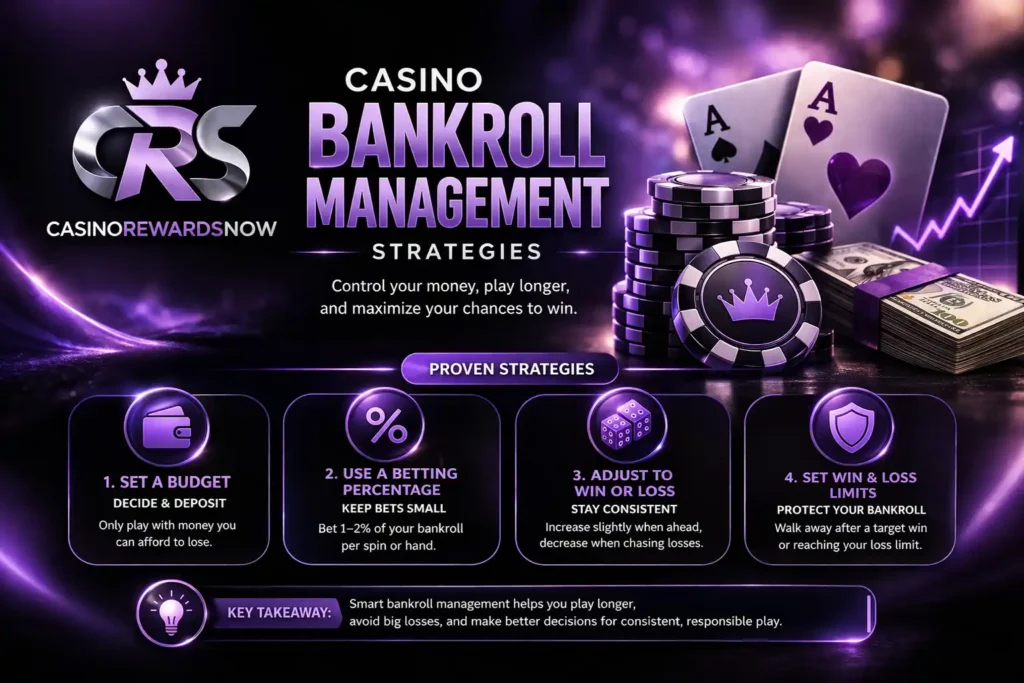
The foundation of all casino bankroll management strategies is your overall gambling budget. This is the total amount of money you are comfortable losing over a certain period, usually weekly or monthly.
A useful way to think about it is as entertainment spending. Just as someone might budget for restaurants, movies, concerts, or subscriptions, gambling should sit in the same general category. It is not a dependable investment, and it should not be treated as a source of stable income.
Your gambling budget should be:
- fixed in advance
- affordable even if fully lost
- separate from essential expenses
- reviewed honestly based on your financial reality
Table 1: Example of a Simple Gambling Budget Structure
| Monthly Disposable Entertainment Budget | Suggested Gambling Budget | Risk Level |
|---|---|---|
| €200 | €20–€40 | Conservative |
| €500 | €50–€100 | Moderate |
| €1,000 | €100–€200 | Controlled but flexible |
| €2,000 | €200–€400 | Higher, but should still stay limited |
This is not a universal formula, but it shows the key principle: the bankroll should fit your real life, not your short-term ambition.
Separate Total Bankroll From Session Bankroll
One of the best strategies is to divide your overall bankroll into smaller session bankrolls. This gives your money structure and prevents one bad day from wiping out the entire amount.
For example, if your monthly bankroll is €300, you might divide it into:
- 6 sessions of €50
- 4 sessions of €75
- 10 sessions of €30
This creates pacing. It also helps emotionally, because a losing session no longer feels like total failure. It is only one part of a larger plan.
Why this works:
A player with a €300 bankroll who takes all €300 into one session is more exposed to tilt, overbetting, and emotional recovery attempts. A player who treats the same €300 as several smaller sessions has more control, more time to reset, and more protection from one bad run.
Table 2: Example of Bankroll Splitting by Session
| Total Bankroll | Number of Sessions | Session Bankroll | Benefit |
|---|---|---|---|
| €100 | 4 | €25 | Good for small casual sessions |
| €200 | 4 | €50 | Balanced and easy to track |
| €300 | 6 | €50 | Strong pacing and control |
| €500 | 5 | €100 | Useful for mixed game types |
| €1,000 | 10 | €100 | Better long-term structure |
This kind of table is useful in an article because readers can immediately visualize how bankroll planning works in practice.
Match Your Bet Size to Your Bankroll
Bet sizing is one of the biggest factors in whether a bankroll lasts or collapses quickly. Even a decent bankroll can disappear fast if the stake size is too aggressive.
Many players choose bets emotionally. They pick a number that feels exciting rather than one that fits the balance and the game’s variance. That usually leads to one of two outcomes: the session ends too quickly, or pressure builds so fast that discipline disappears.
The better approach is to choose a bet size that allows your bankroll room to absorb normal swings.
A helpful way to think about it is this: your bankroll should buy you enough attempts to survive variance.
For slots, that usually means smaller spin sizes. For table games, it means being careful not to let a steady pace trick you into risking too much.
Table 3: Example Bet Size Guidelines by Session Bankroll
| Session Bankroll | Conservative Bet Size | Moderate Bet Size | Aggressive Bet Size |
|---|---|---|---|
| €25 | €0.10–€0.25 | €0.50 | €1 |
| €50 | €0.20–€0.50 | €1 | €2 |
| €100 | €0.50–€1 | €2 | €3–€5 |
| €200 | €1–€2 | €3–€5 | €5–€10 |
These are broad examples, not strict rules. The correct size depends on the game, but the core lesson stays the same: the more aggressive the bet relative to the bankroll, the lower your margin for error.
Understand Variance Before You Risk Your Money
A bankroll does not behave the same way in every game because casino games have different levels of variance.
Variance describes how winnings and losses are distributed over time. Low-variance games tend to produce steadier results with smaller swings. High-variance games can create long losing stretches combined with occasional larger wins.
This matters because bankroll requirements are not only about balance size. They are also about game behavior.
A €50 session bankroll might feel adequate for low-stakes roulette or baccarat, but it may be too small for a volatile slot session if the bet size is not adjusted downward.
Table 4: Game Type vs Bankroll Pressure
| Game Type | General Variance | Bankroll Pressure | Practical Note |
|---|---|---|---|
| Blackjack | Low to medium | Lower if strategy is disciplined | Slower bankroll drain with sensible staking |
| Baccarat | Low to medium | Moderate | Simpler structure helps control |
| Roulette outside bets | Medium | Moderate | Can feel steady but still drains over time |
| Roulette inside bets | Higher | Higher | More swingy than many players expect |
| Online slots | Medium to very high | High | Requires more conservative bet sizing |
| Bonus buys / feature buys | Very high | Very high | Not ideal for fragile bankrolls |
Many players ignore this completely and use the same bet size across different games. That is a mistake. One of the smartest casino bankroll management strategies is adapting your stake size to the variance of the game.
Never Chase Losses
No bankroll plan works if you ignore it during frustration. Chasing losses is one of the fastest ways to destroy discipline.
This usually happens when a player loses part of a bankroll and decides to increase the stake size, extend the session, or deposit more money in order to recover faster. The thinking feels logical in the moment, but in practice it usually increases risk at exactly the wrong time.
Chasing losses is dangerous because:
- emotions are already elevated
- the desire to recover overrides good judgment
- bigger bets make variance more brutal
- the session stops being entertainment and becomes rescue mode
One of the strongest bankroll rules you can have is this: when the session bankroll is gone, the session ends.
No extra deposit. No “last chance.” No doubling because you feel unlucky. The whole point of bankroll management is to avoid making big decisions under emotional stress.
Use Loss Limits and Win Limits
A lot of players understand the need for loss limits, but win limits matter too.
A loss limit is the amount you are willing to lose in a session before you stop. Usually, this is equal to your session bankroll or a clearly defined portion of it.
A win limit is a profit target that tells you when to walk away or at least reduce risk.
Why is this useful? Because many players do something predictable: they recover, then continue, then give back the profit, then lose the original bankroll too. A win limit helps stop that cycle.
Example:
You start a session with €50.
- Loss limit: stop if you lose the €50
- Win limit: stop if you reach €90 or €100
This creates balance. You accept downside in advance, but you also protect upside when the session goes well.
Table 5: Example Session Limit Framework
| Starting Session Bankroll | Example Loss Limit | Example Win Limit | Outcome Logic |
|---|---|---|---|
| €25 | €25 | €40–€50 | Small, disciplined casual session |
| €50 | €50 | €80–€100 | Good for most low-stakes players |
| €100 | €100 | €150–€200 | Allows room without overextending |
| €200 | €200 | €300–€400 | Better for longer controlled sessions |
These numbers are examples, but they show readers how bankroll boundaries can be applied practically.
Do Not Mistake Betting Systems for Bankroll Management
This is an area where many players get confused. Betting systems such as Martingale, Fibonacci, Labouchere, D’Alembert, or Paroli are often presented as clever ways to “manage money.” In reality, they are not the same thing as bankroll management.
A betting system is a method of changing stakes after wins or losses. Bankroll management is the overall financial framework that defines how much you can risk, how you divide your funds, and when you stop.
The difference is critical.
A player can use a betting system and still have terrible bankroll discipline. In fact, some progression systems make bankroll problems worse because they encourage larger and larger bets after losses.
Common issue with Martingale:
The idea is to double after every loss until one win recovers everything. But losing streaks happen, table limits exist, and balances are finite. The system can escalate beyond the bankroll much faster than expected.
A proper bankroll strategy is more defensive. It assumes risk is real and focuses on preservation first.
Adapt Your Bankroll Strategy to the Game You Play
Different casino games require different kinds of discipline.
Slots
Slots are where bankroll mistakes become especially visible. The pace is fast, volatility can be high, and it is easy to spin without feeling the cost in real time. Smaller spin sizes and shorter sessions are usually the safer approach.
Roulette
Roulette feels controlled, especially with outside bets such as red/black or odd/even. But the steady rhythm can cause players to underestimate cumulative losses. Session limits matter a lot here. If roulette is one of your main games, our guide to roulette bankroll tips explains safer bet types, version choice, and basic session control. If roulette is one of your regular games, this live roulette bankroll strategy guide explains how live-table pressure, session limits, and bet sizing affect your results more than most systems do.
Blackjack
Blackjack often has a relatively low house edge when played with decent strategy. That makes it appealing for bankroll-conscious players. Still, fast play and overconfidence can lead to bigger bets than planned. For blackjack-focused players, our blackjack guide explains why rules, pace, and bonus eligibility all matter before you size your stakes
Baccarat
Baccarat is simple, which can make bankroll planning easier. Still, streak-chasing and emotional betting are common, especially after a few wins or losses in a row. If you prefer simpler decision-making, our baccarat guide explains the Player, Banker, and Tie options in a clearer way.
Live casino games
Live games add immersion and social pressure. Because the experience feels more “real,” some players stop following the same limits they would respect in automated online games.
The broader lesson is this: good bankroll management is never one-size-fits-all. It should reflect the pace, volatility, and emotional feel of the game you play most often.
Track Results Honestly
A surprising number of players believe they are managing a bankroll well, but they never record actual results. Without tracking, memory becomes selective. Wins stand out more than losses, and bad habits are easy to ignore.
Basic session tracking can reveal important patterns, such as:
- which games drain your bankroll fastest
- whether you lose control after switching games
- how often you redeposit
- whether certain times of day or moods affect discipline
You do not need a complex spreadsheet. A simple note system works.
What to track:
- date
- game type
- session bankroll
- ending balance
- profit or loss
- emotional notes or mistakes
Table 6: Simple Bankroll Tracking Template
| Date | Game | Session Bankroll | End Balance | Result | Notes |
|---|---|---|---|---|---|
| 06/04 | Slots | €50 | €12 | -€38 | Increased spins too early |
| 08/04 | Roulette | €50 | €72 | +€22 | Stopped near target |
| 10/04 | Blackjack | €75 | €40 | -€35 | Played too long |
| 12/04 | Baccarat | €50 | €95 | +€45 | Good control, left on time |
This type of table also adds SEO value because it makes the article more useful, concrete, and easy to skim.
Keep Gambling Funds Separate From Everyday Money
One of the most underrated bankroll tactics is financial separation. If your gambling money sits in the same place as your rent or grocery money, breaking your own rules becomes too easy.
A separate gambling budget can be managed by:
- using a dedicated entertainment balance
- preloading only a fixed amount
- avoiding instant access to extra funds
- refusing to mix daily finances with casino deposits
The point is not the tool. The point is the barrier. Good bankroll management gets much stronger when there is friction between a bad session and your normal money.
Emotional Control Is Part of Bankroll Management
A bankroll strategy is not only a numbers system. It is also a behavioral system.
Even a mathematically sensible plan can fail if you play while:
- angry
- stressed
- tired
- distracted
- desperate to “fix” your mood with gambling
When emotions are unstable, the urge to break limits becomes much stronger. This is why some of the best bankroll decisions happen before a session starts. Sometimes the correct decision is not to play at all.
That is not weakness. That is discipline.
A session should begin only when you are able to accept both outcomes:
- you might win
- you might lose the planned amount
If you cannot emotionally accept the second outcome, bankroll discipline is already in danger.
Common Bankroll Mistakes That Cause the Most Damage
Many bankroll problems repeat themselves across all player types. Recognizing them early helps prevent them from becoming habits.
Table 7: Common Bankroll Mistakes and Better Alternatives
| Mistake | Why It Hurts | Better Alternative |
|---|---|---|
| Gambling with essential money | Creates real-life financial pressure | Use only disposable entertainment funds |
| Taking full bankroll into one session | Increases exposure to tilt and overbetting | Split bankroll into multiple sessions |
| Betting too large for the balance | Reduces survival time | Lower stake size and extend play |
| Chasing losses | Turns a bad session into a worse one | End the session at the loss limit |
| Ignoring win targets | Leads to profit giveback | Set a realistic cash-out point |
| Using same stakes for all games | Ignores volatility differences | Adjust stake size by game type |
| Trusting betting systems too much | Encourages escalation | Focus on fixed limits instead |
This kind of comparison table works well in SEO articles because it answers reader intent clearly and quickly.
A Practical Example of a Good Bankroll Plan
Imagine a player creates a monthly gambling bankroll of €400. Instead of treating that as one pool to use impulsively, the player divides it into 8 sessions of €50.
The player mainly enjoys slots and roulette.
For slots:
- session bankroll: €50
- spin size: €0.20 to €0.50
- stop-loss: €50
- win target: €80 or more
For roulette:
- session bankroll: €50
- bet size: €1 outside bets
- stop-loss: €50
- win target: €75 to €90
The player also tracks each session and never redeposits on the same day after losing a session bankroll.
This plan is not exciting in a flashy way, but it is exactly the kind of structure that keeps gambling under control. It also makes results easier to evaluate over time.
Why Bankroll Management Supports Responsible Gambling
There is also a wider reason these strategies matter. Bankroll management is one of the strongest practical tools for responsible gambling.
It helps players:
- set affordable financial boundaries
- reduce impulsive play
- avoid emotional escalation
- keep gambling in the entertainment category
- recognize when behavior is becoming unhealthy
Responsible gambling is not only about warnings and limits imposed by operators. It is also about the player building personal rules and respecting them. For the wider safety framework behind these rules, read our responsible gambling guide.
That is why casino bankroll management strategies should not be seen as optional advice. They are a core part of safer gambling behavior.
Final Thoughts
Learning strong casino bankroll management strategies is one of the smartest things any casino player can do. It will not remove the house edge, guarantee profit, or make gambling risk-free. But it can make your decisions more rational, your losses more controlled, and your sessions more sustainable.
The best bankroll strategies are usually simple. Set an affordable gambling budget. Split it into smaller sessions. Use bet sizes that fit the balance and the game’s variance. Define loss limits and win limits. Track results honestly. Never chase losses. And do not confuse betting systems with real financial discipline.
Most importantly, remember that the bankroll should control the session, not the other way around. The moment you let emotion rewrite the plan, the strategy stops working.
Players who manage their bankroll well are not necessarily the luckiest players. They are the ones who protect themselves from the mistakes that make gambling more expensive than it needs to be. Over time, that discipline matters far more than one good run or one bad streak.
Frequently Asked Questions About Casino Bankroll Management Strategies
What is a casino bankroll?
A casino bankroll is the specific amount of money a player sets aside only for gambling. It should be separate from essential expenses such as rent, bills, food, savings, or debt payments. A proper bankroll is made up of disposable money that you can afford to lose without creating financial pressure in daily life.
How do casino bankroll management strategies work?
Casino bankroll management strategies work by helping players control how much money they risk, how they divide that money into sessions, and how much they bet during each session. The goal is to reduce impulsive decisions, avoid chasing losses, protect the bankroll from fast swings, and make gambling more structured and responsible over time.
What is a good bankroll for casino gambling?
A good bankroll depends on your personal finances, but it should always be an amount you can comfortably afford to lose. There is no universal number that works for everyone. For some players, a modest monthly bankroll of €50 to €100 may be appropriate, while others may choose a higher amount. What matters most is that the bankroll fits your budget and stays separate from essential money.
How much should I bet from my bankroll?
Your bet size should match both your bankroll and the volatility of the game you play. In general, smaller bet sizes are safer because they allow your balance to survive normal losing streaks. High-volatility games such as slots usually require more conservative bet sizing than lower-variance games. A sustainable betting approach is one of the key parts of strong casino bankroll management strategies.
Why is bankroll management important in casino games?
Bankroll management is important because it helps players stay in control of their gambling budget, avoid emotional betting, and reduce the risk of large losses in a short period. While it cannot remove the house edge or guarantee profit, it can make gambling safer, more disciplined, and more sustainable by setting clear financial boundaries before play begins.
Should I split my bankroll into session budgets?
Yes, splitting your total bankroll into smaller session budgets is usually a smart strategy. It helps prevent one bad session from wiping out your entire gambling budget and gives you more control over pacing. Session bankrolls also make it easier to set stop-loss limits, protect your monthly budget, and reset emotionally between sessions.