
Casino games are often marketed with numbers that sound simple at first but become confusing very quickly. Two of the most common terms players see are RTP and house edge. They appear in slot reviews, blackjack strategy guides, roulette comparisons, and casino bonus discussions. Yet many players still do not fully understand what these numbers mean, how they relate to each other, and why they matter when choosing a game.
That is exactly why RTP vs house edge explained is such an important topic for anyone who wants to gamble more intelligently. Whether you play online slots, roulette, blackjack, baccarat, or video poker, these two metrics help you understand the mathematical balance between player value and casino advantage.
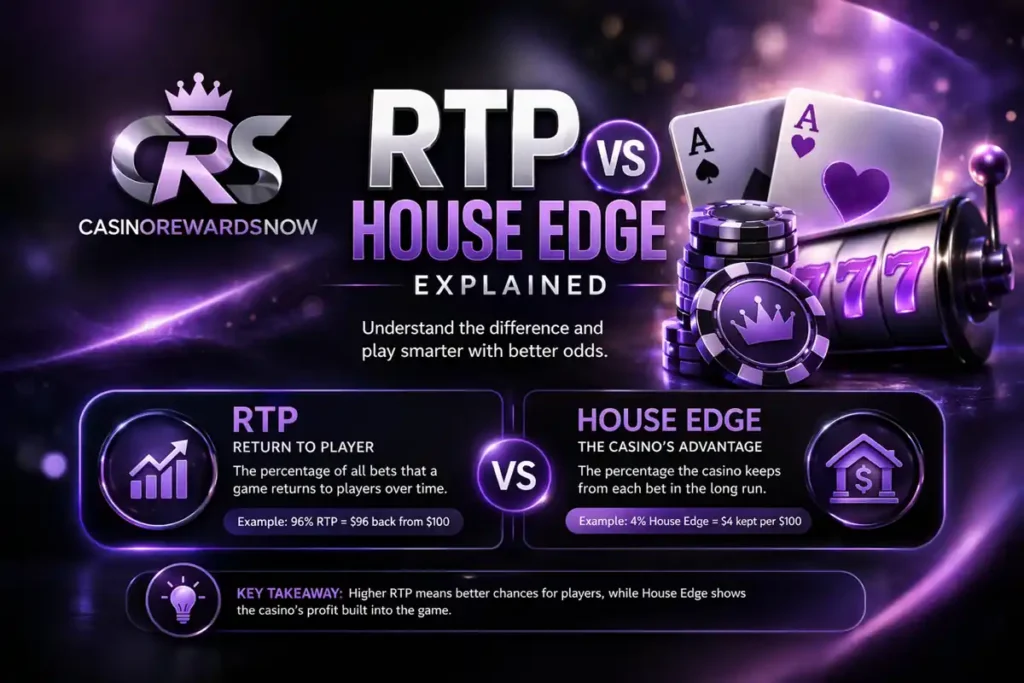
At the most basic level, RTP shows the percentage of wagered money that a game is expected to return to players over the long run. House edge shows the opposite side of that equation: the percentage the casino expects to keep over time. In many cases, the numbers are directly connected. If a game has an RTP of 96%, the house edge is typically 4%. If the house edge is 2.7%, the RTP is usually 97.3%.
That sounds easy enough, but the practical side is more nuanced. RTP is often misunderstood as a short-term promise. House edge is sometimes treated as a hidden cost without context. And in some games, especially table games, player decisions can influence the real return, making the headline number only part of the story.
This guide breaks down the difference between RTP and house edge in clear language, with real examples and comparison tables. It also explains how these concepts affect volatility, bankroll management, game selection, and realistic player expectations. The goal is not just to define the terms, but to help you actually use them when evaluating casino games. Because game math only becomes useful when paired with discipline, see our guide to casino bankroll management strategies.
What Is RTP?
RTP stands for Return to Player. It is the theoretical percentage of all wagered money that a game returns to players over a very long period of time.
If a slot has an RTP of 96%, that means the game is designed to return €96 for every €100 wagered in the long run. The remaining €4 represents the casino’s theoretical advantage.
The key phrase here is in the long run.
RTP does not mean that if you wager €100 today, you will personally receive €96 back. In real play, you might get €20 back, €200 back, or nothing at all. RTP is a statistical model based on thousands or millions of spins, hands, or rounds, not a short-term guarantee for an individual session.
This is where many misunderstandings begin. Players often assume RTP predicts what will happen in the next few minutes. It does not. Instead, it describes what the game is mathematically built to return over time. If you want a more beginner-friendly breakdown, read our guide on what RTP means in casino games.
Simple RTP Example
Imagine 1,000 players each wager a total of €100 on the same slot. Together, they wager €100,000. If the slot has a theoretical RTP of 96%, the game is expected to return about €96,000 to players collectively over the long run. The remaining €4,000 is the casino’s theoretical gross revenue from that activity.
That does not mean each player gets exactly €96 back. Some may win more, some less, and some may lose all of it. RTP works at scale, not at the level of a single guaranteed result.
What Is House Edge?
House edge is the mathematical advantage the casino has over the player on a given game. It is expressed as a percentage of each bet that the casino expects to keep over time.
If a roulette game has a house edge of 2.7%, the casino expects to earn €2.70 for every €100 wagered in the long run. On average, that means players collectively get back €97.30.
House edge is often used more frequently in table games such as roulette, blackjack, baccarat, craps, and poker-based casino games. RTP is used more often in slots and some digital casino products. But mathematically, they usually describe opposite sides of the same structure.
Simple House Edge Example
Suppose you play a game with a 5% house edge and make €1,000 in total wagers over time. The casino’s expected profit from that play is €50, and the expected player return is €950.
Again, that does not mean your exact result will be a €50 loss. In the short run, variance can be much larger than the theoretical expectation. But over many repeated wagers, the numbers tend to reflect the built-in advantage more closely.
RTP vs House Edge Explained in One Formula
In many standard casino games, RTP and house edge are direct complements of each other.
RTP = 100% – House Edge
House Edge = 100% – RTP
That means:
- RTP 98% = House edge 2%
- RTP 96.5% = House edge 3.5%
- House edge 1.24% = RTP 98.76%
Table 1: RTP and House Edge Conversion Examples
| RTP | House Edge |
|---|---|
| 99% | 1% |
| 98% | 2% |
| 97.3% | 2.7% |
| 96% | 4% |
| 95% | 5% |
| 94% | 6% |
This relationship is one of the easiest ways to compare games. If you know one figure, you can calculate the other immediately.
However, the numbers are only useful if you understand what they do and do not tell you. A game with better RTP is mathematically more favorable, but that does not necessarily make it easier, less volatile, or more suitable for every player.
Why Casinos Use Both Terms
Casinos and game providers use RTP and house edge in slightly different ways depending on the game type and audience.
Slots are commonly marketed with RTP because it sounds player-friendly. “Return to player” emphasizes what comes back rather than what the casino keeps.
Table games often use house edge because strategy guides and game analysis traditionally focus on the casino advantage. For games like roulette and blackjack, the house edge is often easier to compare across rule variations.
In practical terms, both numbers serve the same purpose: they help describe the mathematical value of a game. But the language changes the focus.
- RTP asks: how much comes back to players?
- House edge asks: how much does the casino keep?
That is why many beginner guides sound inconsistent. One page talks about RTP. Another talks about house edge. But once you understand the relationship between them, the confusion disappears.
RTP Is Not a Short-Term Promise
One of the biggest myths in gambling is the idea that RTP must “balance out soon.” This leads to mistaken beliefs such as:
- a slot is due for a win because it has not paid recently
- a high-RTP game will almost always perform better in one session
- a player is guaranteed to receive close to the RTP number after enough spins in a short evening
None of these assumptions are correct.
RTP describes the game’s design over a very large sample size. In short sessions, actual outcomes are heavily affected by variance. A player on a 96% slot could lose 100 spins in a row or hit a large win in the first five minutes. Both outcomes are possible without contradicting the long-term RTP.
This is especially important for slot players. Two slots can have nearly identical RTP figures, but one may feel much harsher because its volatility is higher. That means large parts of the return may be concentrated in rare bigger wins rather than frequent smaller ones.
So while RTP matters, it should never be treated as a short-term prediction tool.
House Edge Is More Than Just a “Cost”
House edge is often described as the casino’s profit margin, but that can sound abstract. A more useful way to think about it is this:
House edge is the average cost of access to the game over time.
If you repeatedly wager on a game with a 1% house edge, your expected long-term cost is lower than on a game with a 6% house edge. That does not mean you will lose slowly and smoothly every session, but it does mean the game is mathematically more favorable.
This perspective helps players compare games more effectively. A lower house edge usually means:
- better long-term value
- a slower expected drain on bankroll
- more playtime for the same money, all else being equal
Of course, actual experience depends on volatility, stake size, and luck. But from a pure mathematical standpoint, lower house edge is usually better for the player.
Real-World Examples of RTP and House Edge
The easiest way to understand RTP vs house edge explained is to look at real casino game examples.
European Roulette
European roulette has 37 pockets: numbers 1 to 36 plus a single zero. The presence of the zero creates the casino advantage.
If you bet on red, you almost have a 50/50 chance, but not quite, because the green zero is neither red nor black. That difference creates a house edge of 2.7%, which corresponds to an RTP of 97.3%.
American Roulette
American roulette adds a double zero, increasing the total to 38 pockets. That additional house number raises the casino advantage.
The result is a house edge of 5.26% and an RTP of 94.74%. To see how these numbers translate into real gameplay, read our guide on how roulette odds and bets work.
Blackjack
Blackjack is more complicated because the real house edge depends on the rules and the player’s decisions. With favorable rules and optimal basic strategy, the house edge can be around 0.5% or even lower in some games. That would mean an RTP of roughly 99.5%.
But if the player makes poor decisions consistently, the effective house edge becomes much higher. If you play blackjack, our blackjack bonus and rules guide explains what to check before choosing a casino or using a promotion.
Slots
Slots often advertise RTP figures such as 94%, 96%, or 97%, depending on the title and operator settings. The corresponding house edge would be 6%, 4%, or 3%. Unlike blackjack, player decisions usually do not affect the math much, because slots are mostly fixed-expectation games once you choose your bet.
Table 2: Common Casino Games Compared
| Game | Typical RTP | Typical House Edge | Key Note |
|---|---|---|---|
| Blackjack (basic strategy) | 99% to 99.5% | 0.5% to 1% | Strong player decisions matter |
| Baccarat Banker Bet | 98.94% | 1.06% | One of the better standard bets |
| European Roulette | 97.3% | 2.7% | Better than American roulette |
| Craps Pass Line | 98.59% | 1.41% | Good value on core bets |
| Average Online Slot | 95% to 96.5% | 3.5% to 5% | Volatility varies widely |
| American Roulette | 94.74% | 5.26% | Double zero increases cost |
This table shows why informed players often prefer certain table games when they want the lowest mathematical disadvantage. But it also shows why slots remain popular: even with a higher house edge, they offer accessibility, variety, and bigger jackpot-style potential.
Skill-Based Impact: Why Blackjack and Video Poker Are Different
Not all games treat the player the same way. In games like blackjack and video poker, your decisions influence the expected return. That means the advertised RTP or house edge may assume correct play.
For example, a video poker machine might be described as 99.5% RTP, but that figure may only apply if the player uses perfect strategy. Most players will perform below that level in real conditions, which means their practical RTP may be lower and the effective house edge higher.
The same is true in blackjack. A good strategy reduces the house edge. A poor strategy increases it. That is a major difference from slots, where player choices rarely change the core RTP in a meaningful way.
This is one reason why comparisons between games can be misleading if context is missing. A slot with 96.5% RTP may be more realistic for an average player than a blackjack game with 99.5% theoretical RTP if the player does not know basic strategy.
In other words, the best mathematical game is not always the best practical game for every player. If you want to see how strategy changes the practical numbers, our guide to video poker RTP and house edge explains why the advertised return is not always the return most players actually realize.
RTP and House Edge in Bonus Hunting
These terms also matter when bonuses are involved. Many players focus only on wagering requirements and ignore the RTP or house edge of the games they use to complete rollover.
That can be a mistake.
If a bonus allows you to use a slot with 96.5% RTP, the expected cost of wagering may be lower than if you use a slot with 94% RTP. The difference becomes more important over large amounts of required wagering.
Let’s imagine a player must complete €5,000 in wagering.
- On a 96% RTP game, the expected cost is about €200
- On a 94% RTP game, the expected cost is about €300
That extra 2% house edge difference increases the theoretical cost of the rollover by about €100.
This does not mean the higher-RTP game guarantees a better outcome in one session. But it does show why RTP and house edge are important for bonus strategy, especially when you must place many total bets.
Variance: The Missing Piece in Many Comparisons
A lot of articles explain RTP and house edge but forget to explain variance. That creates an incomplete picture.
Variance, often discussed as volatility in slots, describes how wins and losses are distributed over time. Two games can have the same RTP but feel completely different because of how and when they pay.
For example:
- Game A has 96% RTP with low volatility
- Game B has 96% RTP with high volatility
Mathematically, they return the same amount over the very long run. But in practice:
- Game A may produce smaller, more frequent wins
- Game B may produce longer losing streaks and rarer larger payouts
This matters because players experience the game in sessions, not in millions of rounds. A game with a good RTP can still feel brutal if its volatility is high. Likewise, a game with slightly lower RTP may feel smoother if wins are more frequent.
So when comparing casino games, RTP and house edge tell you about long-term value, but variance helps explain short-term experience. For a practical example, see how RTP and volatility in progressive slots can change the player experience even when the math looks similar
Example: €100 Budget Across Different Games
Let’s say a player has a €100 bankroll and plans to make many small wagers. Here is how RTP and house edge help frame the expected long-term cost.
Table 3: Expected Long-Term Cost on €100 Wagered
| Game | RTP | House Edge | Expected Long-Term Cost per €100 Wagered |
|---|---|---|---|
| Blackjack with good strategy | 99.5% | 0.5% | €0.50 |
| Baccarat Banker Bet | 98.94% | 1.06% | €1.06 |
| European Roulette | 97.3% | 2.7% | €2.70 |
| Slot at 96% RTP | 96% | 4% | €4.00 |
| American Roulette | 94.74% | 5.26% | €5.26 |
This does not mean you can sit down with €100 and expect to lose exactly those amounts. Real outcomes vary. But as a long-term benchmark, the table shows why some games are mathematically cheaper to play than others.
If bankroll preservation is important, lower house edge matters.
Which Metric Is Better for Players to Use?
The answer depends on what you are trying to compare.
Use RTP when:
- evaluating slots
- comparing digital casino games
- estimating theoretical player return
- analyzing bonus-friendly game choices
Use house edge when:
- comparing table games
- reading strategy guides
- estimating long-term casino advantage
- understanding the expected cost of a bet
In truth, most players should understand both. Since RTP and house edge are usually two sides of the same equation, knowing one helps you interpret the other.
The more important point is not choosing one term over the other. It is learning to translate them correctly and put them in context.
Common Misunderstandings About RTP and House Edge
A lot of confusion comes from a few repeated myths.
“A 96% RTP slot gives me €96 back every €100 I play”
Not in one session. It is a long-term theoretical average across a huge number of wagers.
“Lower house edge means I will probably win”
Not necessarily. It means the game is mathematically less unfavorable, not that it produces guaranteed short-term profit.
“All players experience the same RTP”
No. Individual results vary widely in the short term, and in skill-based games player decisions can change real outcomes.
“House edge and RTP are different systems”
They are usually complementary ways of describing the same built-in math.
“RTP alone tells me the best game”
Not completely. You should also consider volatility, bankroll, rules, bonus conditions, and your own skill level.
Understanding these points helps players make better decisions and avoid unrealistic expectations.
Practical Takeaways for Choosing Casino Games
When deciding what to play, use RTP and house edge as filters, not promises.
A practical approach looks like this:
First, compare the theoretical value.
A game with 98% RTP is generally better than one with 95% RTP, assuming the structure is otherwise similar.
Second, check whether skill affects the outcome.
If a game requires optimal strategy to reach the listed return, be honest about whether that applies to you.
Third, consider variance.
A strong RTP is useful, but a high-volatility game may still create large short-term swings.
Fourth, think about your goal.
If you want longer playtime, lower house edge and lower volatility may matter more. If you are chasing larger upside, you may accept more volatility even with a higher edge.
Finally, use the information to set expectations.
No casino game is built to produce guaranteed profit for the average player over time. RTP and house edge help you understand how expensive or efficient the entertainment is likely to be.
Final Thoughts
If you have ever felt confused by casino math, the good news is that RTP vs house edge explained becomes much simpler once you see the relationship clearly. RTP shows how much a game returns to players in theory over the long run. House edge shows how much the casino expects to keep. In most cases, they are two sides of the same number.
That does not make them unimportant. In fact, they are among the most useful concepts in gambling because they help you compare games beyond marketing language and surface impressions. They tell you which games are mathematically more favorable, which bets are more expensive over time, and why rule variations can make such a big difference.
Still, these numbers should always be read with context. RTP is not a short-session promise. House edge is not a guaranteed loss per hour. And neither metric alone explains volatility, strategy requirements, or personal bankroll risk.
The smartest way to use them is as part of a bigger picture. Compare the percentages, understand the rules, recognize the role of variance, and be realistic about what the math actually means. Once you do that, casino game comparisons become much clearer.
In the end, informed players do not just ask whether a game looks fun. They also ask whether the numbers behind it make sense. And that is where understanding RTP and house edge really pays off.
FAQ
Is RTP the same as house edge?
Not exactly, but they are closely related. In many casino games, RTP and house edge add up to 100%. If RTP is 96%, the house edge is usually 4%.
Is higher RTP always better?
From a mathematical standpoint, yes. A higher RTP means the game returns more to players over the long run. But volatility and game rules still matter.
Why do slots use RTP while roulette uses house edge?
It is mostly a difference in presentation. Slots are usually marketed with RTP, while table games are often analyzed using house edge.
Can player skill change RTP?
In some games, yes. Blackjack and video poker are good examples. Correct strategy can improve the real return, while poor decisions can make it worse.
Does a low house edge mean I will win more often?
Not necessarily. It means the game is mathematically less costly over time. Short-term results can still vary a lot.
What is more useful for comparing casino games?
Both are useful. RTP is often easier for slots, while house edge is common in table games. The important thing is understanding how to translate one into the other.